Introducing Nipun
However you're sharing this gathering — a note to friends, a WhatsApp message, a printed program, a few words before the circle begins — here are some words and photos to help. Use what serves, and make it your own.
In a Few Words
For an invitation, a message or a program, where a sentence is all the space you have.
Nipun Mehta, Founder of ServiceSpace
Nipun Mehta is the founder of ServiceSpace, a global, volunteer-run community working at the intersection of technology, volunteerism and gift culture.
Nipun Mehta is the founder of ServiceSpace, a volunteer-run ecosystem of more than 1.5 million members that has grown since 1999 without any fundraising.
A Little Longer
For an event page, a newsletter, or anyone who wants to know a bit more.
Short
Nipun Mehta is the founder of ServiceSpace, a volunteer-run ecosystem of more than 1.5 million members that has grown since 1999 without any fundraising. Its experiments in generosity — from Karma Kitchen to Awakin Circles — are the subject of a Harvard Business School case. Nipun and his work have also been featured in more than 50 books. Honored by the Dalai Lama as an “Unsung Hero of Compassion” and appointed by President Obama to a White House council on poverty and inequality, he now explores how artificial intelligence might deepen human connection rather than replace it.
Medium
Nipun Mehta is the founder of ServiceSpace, a global incubator of projects at the intersection of volunteerism, technology, and gift culture. In 2001, at twenty-five, he quit his software job to become a “full-time volunteer,” with a plan that covered just six months. What began with four friends has grown into a volunteer-run ecosystem of more than 1.5 million members — without any fundraising.
ServiceSpace’s experiments in generosity, from DailyGood and Karma Kitchen to Awakin Circles, are the subject of a Harvard Business School case. Nipun and his work have been featured in more than 50 books, including Adam Grant’s Give and Take and Dacher Keltner’s Awe. He has been honored by the Dalai Lama as an “Unsung Hero of Compassion” and appointed by President Obama to a White House council on poverty and inequality. He has spoken in United Nations halls and sat in thousands of living-room circles around the world.
One of his most formative experiences was walking 1,000 kilometers across India with his wife of six months, living on a dollar a day — an experience that shaped his widely read University of Pennsylvania commencement address. Today, he explores how AI might deepen human connection rather than replace it. His mission statement remains simple: “Bring smiles in the world and stillness in my heart.”
Full
Nipun Mehta is the founder of ServiceSpace, an incubator of projects working at the intersection of volunteerism, technology, and gift culture. What started as an experiment with four friends in Silicon Valley has grown into a global ecosystem of more than 1.5 million members that has delivered millions of dollars in service for free — run by volunteers, without any fundraising. The work is the subject of a Harvard Business School case, and Nipun and his work have been featured in more than 50 books, including Adam Grant’s Give and Take and Dacher Keltner’s Awe. Gary Zukav devoted a chapter of Universal Human to Nipun’s story and included ServiceSpace in the book’s dedication. Nipun has received many honors, including the Jefferson Award for Public Service, the Dalai Lama’s Unsung Hero of Compassion, and the Goi Peace Award; Germany’s OOOM magazine named him among the 100 Most Inspiring People of 2020. President Obama appointed him to a White House council on poverty and inequality. He is routinely invited to share his message of “giftivism” with audiences ranging from inner-city youth to international dignitaries at the United Nations; his UPenn commencement speech has been read by millions.
Nipun’s high-school goal was to become either a tennis pro or a Himalayan yogi. Instead, by the third year of his Computer Science and Philosophy degree at UC Berkeley, he began a software career at Sun Microsystems. Dissatisfied with the dot-com greed of the late 90s, he went to a homeless shelter with three friends to “give with absolutely no strings attached.” They ended up creating a website — and an organization named ServiceSpace. Over the years they built thousands of websites for nonprofits while incubating projects from DailyGood and KarmaTube to Smile Cards and Karma Kitchen. In 2001, at twenty-five, Nipun quit his job to become a “full-time volunteer,” with no plan of survival beyond six months. So far, so good.
In January 2005, Nipun and Guri, his wife of six months, set everything aside for an open-ended walking pilgrimage across India — “to use our hands for random acts of kindness, our heads to profile inspiring people, and our hearts to cultivate truth.” Living on a dollar a day, they walked 1,000 kilometers before settling at a retreat center to meditate for three months. Today they live in Santa Cruz, rooted in a practice of small acts of service. He has sat in thousands of living-room circles around the world, and his current work explores how AI might deepen human connection rather than replace it. The journey continues.
For Your Audience
A line or two to add to any of the above, depending on who is in the room.
Business & leadership
His work is the subject of a Harvard Business School case, “Joy in Service: Nipun Mehta on Designing for Generosity,” and is featured in Adam Grant’s bestseller Give and Take. ServiceSpace began with an unusual design choice: instead of five staff working forty hours a week, forty volunteers giving five hours a week. More than 25 years and 1.5 million members later, it is still asking the same question: what designs emerge if we assume that people want to be generous?
Technology & AI
Trained in computer science at UC Berkeley, Nipun began his career at Sun Microsystems before leaving to become a full-time volunteer. Today, through Awakin AI and his “Deep Data” manifesto, he explores a question at the frontier of technology: can artificial intelligence help us grow our heart intelligence, and not just our productivity?
Social change & community
Nipun’s work explores how small acts of service, and the inner transformation they spark, can add up to large-scale social change. Through ServiceSpace, a volunteer-run ecosystem of more than 1.5 million members, he has spent more than 25 years experimenting with trust and everyday generosity as the foundation of collective action.
Contemplative gatherings
Every Wednesday from 1996 until the pandemic, Nipun’s parents opened their living room to as many as 63 guests for an hour of silence, a circle of sharing, and a home-cooked meal — more than 50,000 meals in all. The circle continues online, and Awakin Circles now gather in hundreds of living rooms across more than a dozen countries. In 2005, he and his wife Guri walked 1,000 kilometers across India on a dollar a day, and then sat in meditation for three months. Gary Zukav devoted a chapter of Universal Human to Nipun’s story and included ServiceSpace in the book’s dedication.
Students & young people
At twenty-five, Nipun quit his job with no plan beyond six months. His UPenn commencement address, on what he learned walking across India, has been read by millions. His one indulgence? Watching Steph Curry play basketball — mostly, he says, for Curry’s humility.
Institutional settings
Nipun and his work have been featured in more than 50 books, including works by Adam Grant and Dacher Keltner. ServiceSpace is the subject of a Harvard Business School case, and its story has been covered by media from CNN to The Wall Street Journal. Nipun has spoken in United Nations halls and sat in thousands of living-room circles, and has been honored by the Dalai Lama as an “Unsung Hero of Compassion” and appointed by President Obama to a White House council on poverty and inequality.
Welcoming Him In
About a minute, written for the ear — for whoever opens the gathering. The warmest welcomes often begin with a line of your own: why you invited him, or what you hope people will carry home.
In 1999, four friends walked into a homeless shelter in Silicon Valley and said, “We want to help. We don’t know how.” They ended up building a website. One of them was Nipun Mehta, who two years later quit his software job to become a full-time volunteer. He has been one ever since.
That experiment became ServiceSpace: a volunteer-run community of more than 1.5 million members that has never fundraised. Along the way, they’ve created restaurants where the bill is always zero, kindness cards passed between strangers, and circles of silence and sharing in living rooms around the world — beginning with his parents’ living room, where more than 50,000 meals have been served.
The work is now the subject of a Harvard Business School case. The Dalai Lama honored Nipun as an “Unsung Hero of Compassion,” and President Obama appointed him to a White House council on poverty and inequality.
Underneath it all is a simple question: what happens when we design for generosity instead of self-interest? Today, Nipun is bringing that same question to the age of artificial intelligence, exploring how technology might deepen, rather than diminish, our humanity.
Please join me in welcoming Nipun Mehta.
Photos
Full-resolution portraits. For circles, retreats and friends along the way, see all photos.
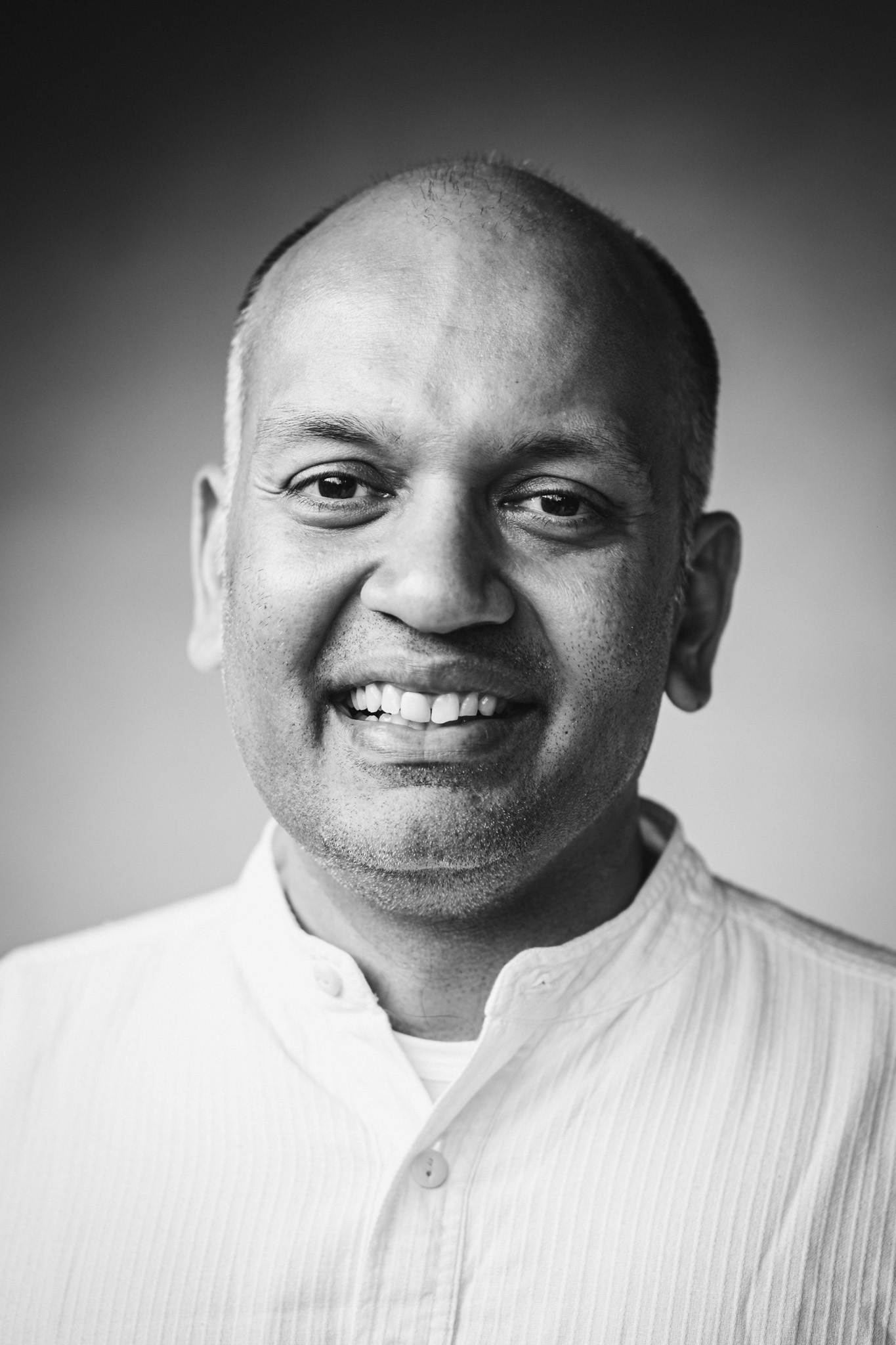


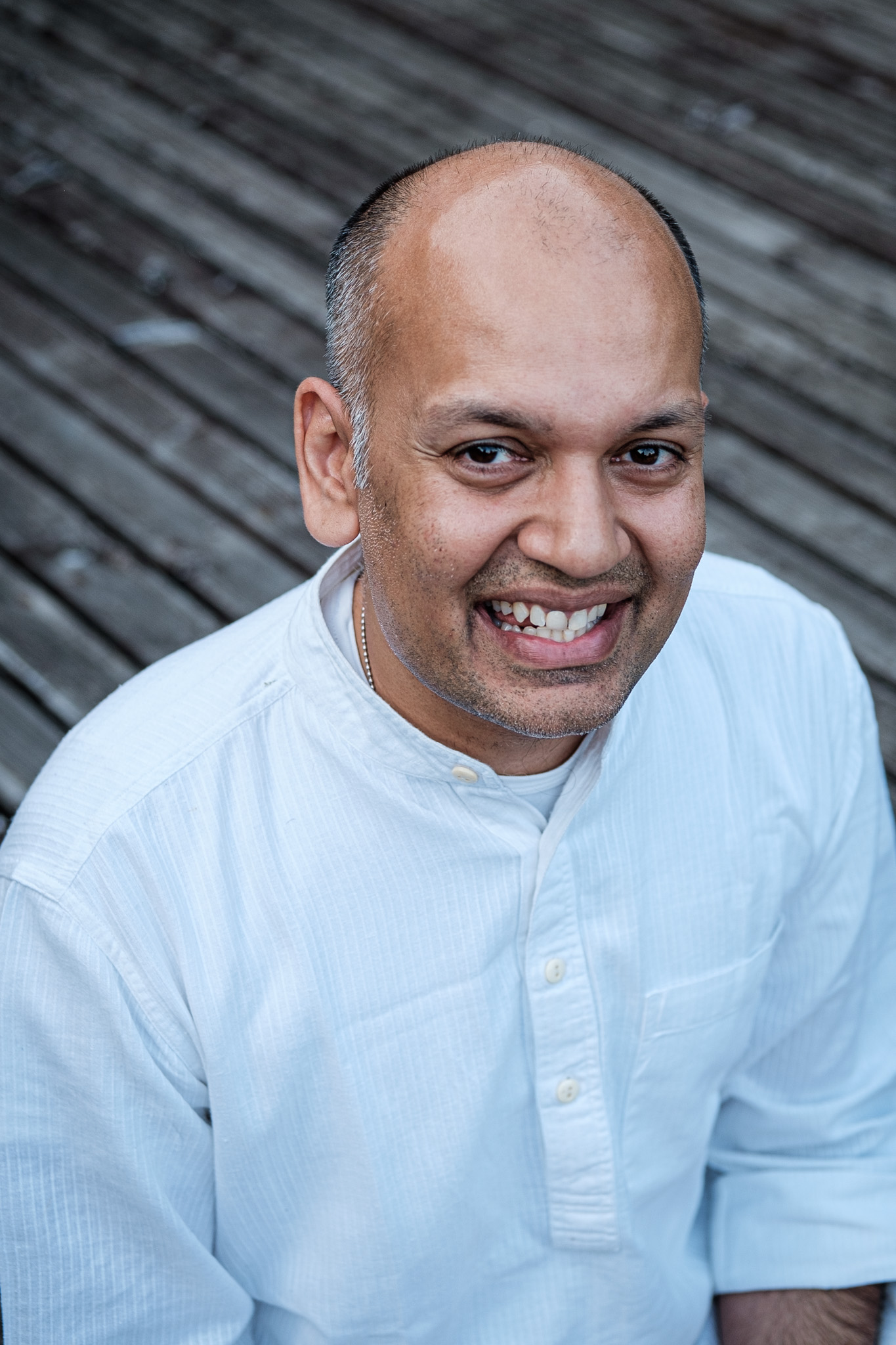

Free to use with a simple credit: “Courtesy of Nipun Mehta / ServiceSpace.”
Looking for the longer story? Read the journey, or browse past talks and articles.