Who Is Giving to Whom?
November 2, 2026

In 2013, a young man named Zilong Wang set off from Massachusetts on a bicycle he called the White Dragon Horse. His destination was California. His plan for sleeping was less certain. Each evening he would knock on a stranger's door and ask to pitch a tent in their backyard.
The first night he couldn't bring himself to knock. He found an empty Boy Scout camp instead, where the mosquitoes ate well and ants poured out of a disused shower hose. The second night he knocked. Most people said no. About one in five said yes.
Seventy-five days later he reached the Pacific, having slept in the yards and sometimes the homes of people he had never met. Some mornings, when he rode off, both he and his hosts had tears in their eyes.
Who was giving to whom?
• • •
Now imagine a different invitation.
Someone with considerable resources is gathering people for a retreat they believe could change lives. They want to help, and they want their help to reach as many people as possible. If everyone contributes toward their own travel, the same pool stretches further. There is stewardship in that, and a sincere wish that people arrive with intention.
Their reasons are good ones. They have watched money bend a room out of shape. They know the dangers of dependency and the value of making resources last. But people with considerable means can also know a particular loneliness: the never-quite-settled question of whether others seek their company or their capacity. Underneath the careful arithmetic may lie a quieter question.
Would you still come if I weren't paying?
Now stand on the other side of the door. A schoolteacher receives the invitation. The requested contribution is more than she earns in a month. She understands the logic of shared sacrifice; she has spent her working life making scarce things stretch. What she doesn't understand is why the cost of demonstrating intention falls so differently on different people. For the host, the contribution is barely noticeable. For her, it decides whether she can come at all. She doesn't hear arrive with intention. She hears a test she may not be able to afford.
And she has a question of her own.
Would you still want me there if my presence cost you something?
She would gladly bring what she has: a story from her classroom, a pair of hands in the kitchen, a friendship neither of them can yet imagine. What she cannot bring is money she doesn't have.
Neither question is unreasonable. The host doesn't want to be reduced to a wallet. The teacher doesn't want to be reduced to a beneficiary. Each is protecting something precious, and each may be preventing the very thing they hope to find.
They are not standing in the same place, of course. The host sets the terms and controls the resources. The teacher bears a cost that would barely register for the host. Their vulnerabilities are recognizably human on both sides; their power is not equal.
There is an old teaching about three kinds of giving. Beggarly giving offers the least of what we have and keeps one hand on it. Friendly giving shares openly, without much calculation. Kingly giving offers the best of what we have, from a sense that we were only ever caretakers of it. Most of us move among the three, sometimes in the same afternoon. We give freely, then find ourselves wondering whether the gift was used well, appreciated enough, received in the spirit we intended. Even an open hand can keep an invisible grip. Kingly giving isn't careless about outcomes. It is simply less attached to controlling them.
Frugality is beautiful when it's worn on oneself. Gandhi wore the cloth he spun. Careful stewardship can be its own form of service. But frugality changes character when we ask others to bear its costs. Every principle has a cost, and the question is whether we are willing to bear some of it ourselves, or whether, without quite noticing, we have asked someone else to bear it for us. We can be so careful about what our generosity accomplishes that we forget to notice what it is doing to us.
Yet simply covering the ticket doesn't settle everything either. Money can remove the barrier at the door without touching either question.
So what would touch them?
• • •
Years after his first crossing, Zilong set out on another pilgrimage of sorts, traveling light and again depending on the kindness of strangers.
Along the way he drew on a Buddhist teaching: the inner state of the person receiving a gift can shape how much good the gift does. The same bowl of rice, placed in the hands of someone cultivating virtue, may bear fruit beyond what either person can see. So Zilong began asking himself a strange question. If strangers were going to share their bread and their roofs with him, what kind of person could he become so that their generosity would bear the richest fruit?
He kept simple vows. He sat in silence. He tried to listen more than he talked. He was still, by any ordinary accounting, the one asking for shelter. But something had been moving in both directions from the first open door, and his practice was a way of noticing it, honoring it, and taking part in it more fully. He was giving, not by repaying his hosts or performing gratitude, but by becoming someone in whom their kindness could ripen.
He was receiving with a giver's heart.
Nobody asked this of him. No host demanded he be worthy of their porch. It was his answer to having been received, freely chosen, which is the only way it works. Make it a requirement and you have replaced a financial eligibility test with a spiritual one. The gift didn't come because he was virtuous. The gift became an invitation to grow.
And that is an answer to the host's question, too. Would you still come if I weren't paying? Perhaps not, the first time. But the reason someone accepts an invitation need not be the reason the relationship endures. A person might come for a free meal and find a friend. Someone might take the flight for the opportunity and leave with a question that rearranges their life. We rarely arrive anywhere with pure intentions. We can only leave enough room for our intentions to change.
• • •
What is the corresponding practice for the one who pays?
Not giving more. Learning to receive. Or perhaps, first, learning to see what they are already receiving.
Someone can give generously for years and still stand at the center of every gift. Their resources make things possible; their name is remembered; people thank them, defer to them, seek their attention. They may have received an abundance of trust, wisdom, and affection without ever recognizing those as gifts. The question isn't only what their resources can accomplish. It's whether their giving still has the power to change them.
I once had dinner with a man whose resources dwarfed mine. He had asked to meet with a question I hadn't expected. "I know all about giving," he said. "But I don't know about receiving."
We talked for a long time. Then the check arrived.
I reached for it. He insisted. We went back and forth, and I joked that both our bank accounts had plenty of zeros, his just had a one in front of them. A man who had spent the evening asking about receiving now found himself unable to let someone else pay for his dinner. Was that generosity? Habit? Discomfort at being treated? Some of each, probably. We didn't need to settle it. I offered a compromise instead: I'd pay for our table, and he could anonymously pay for another.
He liked that. He picked a couple across the room. We called over our waitress, Mandy, and asked her to bring them a small card with the news, and not to say who had done it.
Mandy went over. My friend tried not to look, then began watching their reflection in the window. I tried not to look either, and found myself watching him.
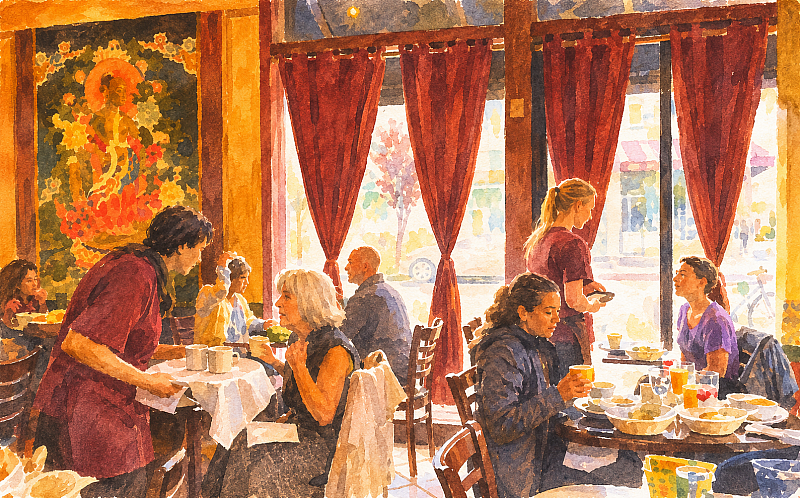
When Mandy came back she was beaming. The couple had been bewildered. Who had done this, and why? Was this normal here? They were visiting from out of town, and joked that if people behaved this way, maybe they should move.
My friend was smiling just as widely. I asked him: were you giving, or receiving?
He had paid. But he had been receiving long before Mandy returned: the freedom to ask an unfamiliar question, the chance to be surprised. Mandy had carried the gift and come back with her own joy. Two strangers had received a meal and somehow given something back to a man who could have bought them a thousand. None of that appeared on the bill.
He had arrived knowing how to give money. That evening, perhaps, he glimpsed how much he was already receiving.
• • •
We tend to imagine generosity as a movement in one direction. One person has something, another needs it, and a gift crosses the distance between them. But that is only what the most visible currency tells us.
The schoolteacher needs help with a ticket. That need is real. But she arrives with other forms of wealth: years of experience, relationships, attention, a way of seeing the world. The ticket makes their meeting possible. It doesn't create those gifts. They were there before the invitation, whether or not anyone recognized them. And what either person will receive from the encounter is not theirs to decide in advance. We don't get to decide, alone, what our generosity means to someone else.
At dinner we hadn't resolved any of that. We simply found another way to act. I paid for our meal; my friend paid for strangers. What followed belonged to neither of us.
You can design the invitation. You cannot choreograph the dance.
Transactional exchange remembers who gave first. It wants the balance restored, and even paying forward becomes a ledger if it's expected. But the deeper blind spot is assuming we know what is being exchanged at all. One person gives money and receives trust. Another receives shelter and offers companionship. None of it converts to a common currency without losing something. The dance begins when those quieter movements come into view, not because the receiver has finally found a way to repay the giver, but because both begin to see that the relationship was never as one-directional as it looked.
Yet the dance cannot be required. If someone offers help expecting transformation in return, the gift has acquired a price. If someone accepting help is expected to repay it with wisdom, gratitude, or friendship, we have only invented another currency for the same old ledger. Both are free to offer. Both must stay free to receive, decline, disagree, and leave unchanged.
A gift should be complete even if nothing comes back. That isn't the failure of reciprocity. It is what makes the real kind possible.
• • •
So what does this ask of us?
We tend to begin with the mechanics. Who qualifies for help? How much should we offer? What would be fair? These are real questions, especially when resources are limited, and anyone entrusted with them owes someone an answer. But if they are the only questions, we may build an impeccable ledger and miss the person standing at the door. Keep the accounting rigorous and the hospitality light. The one giving can handle the paperwork without making the one receiving prove how much they need it.
And begin somewhere else. Less of who qualifies, or even who would we miss? Perhaps the deeper question is: what might make this room more generous? Whose presence might stretch our ways of seeing, whose differences might deepen our listening, whose absence might reveal a blind spot we didn't know we had? A room is not simply the sum of the people invited into it. A collection of generous individuals don't always make a generous room. Something happens between them, and we rarely know in advance what—or who—will make that possible.
Then offer what we can, in a way the other person can actually receive. Sometimes that means removing an obstacle entirely; a bridge that stops halfway across the river hasn't built a crossing. Sometimes it means sharing a burden, or making room for someone to contribute in ways we hadn't imagined. And remember that the practice belongs to both people. The one with resources may need to loosen their grip on control, on credit, on the expectation that the gift will accomplish what they intended. The one receiving may need to loosen the fear of indebtedness, or the belief that accepting help makes them smaller. Neither has to pass a test of virtue. Both are free to discover something about themselves in the encounter.
None of this erases the differences in our circumstances. Money pays for a ticket; kindness alone doesn't. Power still matters, and need doesn't vanish because we have noticed other forms of wealth. The direction of financial support remains clear. The direction of generosity is harder to draw. And neither person is only what they possess, or only what they lack.
The one who funds a gathering might wash dishes, and let a stranger unsettle what they thought they knew. The one whose journey was made possible might bring a story that changes the room. Someone with no money might offer the only hour of undivided attention another person receives all week. None of these gifts is interchangeable, and pretending otherwise is its own small lie. But unequal resources need not become unequal belonging.
Money can buy the ticket. It cannot buy the dance. We can open a door. We cannot decide what will happen when someone walks through it.
• • •
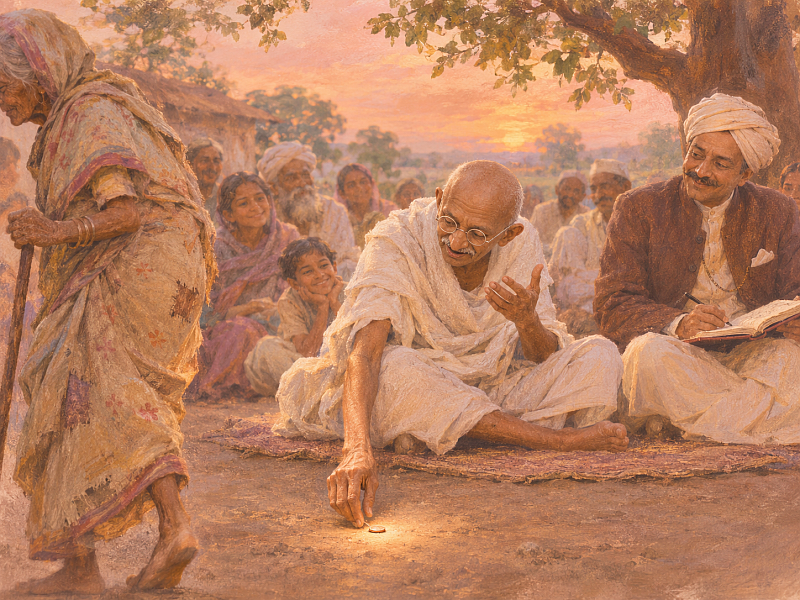
Gandhi was once raising money for the spinning movement in Orissa. During a gathering, an elderly woman made her way past the volunteers and placed a copper half-anna at his feet. He picked it up and kept it.
Jamnalal Bajaj, who kept the accounts, asked for it. He handled cheques worth thousands, he protested, laughing; surely he could be trusted with a coin. Gandhi wouldn't give it up. A rich man parting with a thousand gives little, he said. She had given what she could scarcely spare.
Bajaj kept the cheques. Gandhi kept the coin.
The treasurer saw a coin that belonged in the accounts, and he wasn't wrong; the movement needed someone to count. Gandhi saw the life behind the offering, and received her not as someone the work existed to help but as someone the work belonged to. It would be easy to read this as a story about small gifts and great sacrifice, and it is. But Zilong's question runs the other way through it. Here was a man who had received millions, and a single half-anna could still stop him in his tracks. What did he have to keep alive in himself for that to be possible? The woman had already left before anyone could thank her. Her coin did not erase the distance between her and the men collecting donations. But for a moment another kind of wealth became visible, and the movement had the chance to become something more than an enterprise funded by the rich and carried out for the poor. It could become something they were building together.
Generosity doesn't create our interdependence. It can help us see it. One person arrives with resources and a hope for something real. Another arrives with a need and a fear of owing. Each sees only part of the other's wealth, and only part of their own.
Then a gift opens something. What looked like a one-way offering reveals other currents: attention, trust, companionship, the quiet wealth of being received. The giver discovers what they have been receiving all along. The receiver discovers what they have been offering without knowing it.
The dance isn't the moment when they exchange places. It's what becomes possible when they no longer need to.
Perhaps that is how generosity changes us: our perception begins to catch up with our interdependence.