The Point Was Never Only To Win
September 29, 2026
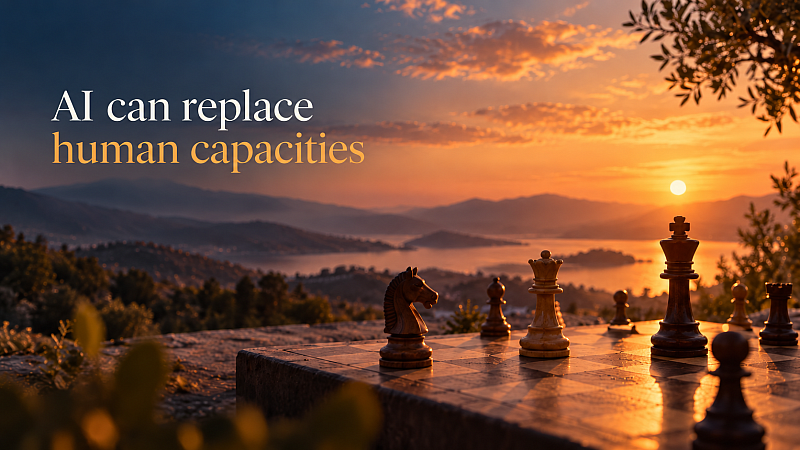
In 1997 a computer named Deep Blue beat the world chess champion, and chess, by all rights, should have packed up its sixty-four squares and gone home. What was left to prove? The machine was better, and it would only get better.
And yet we kept playing.
More people are playing chess now than perhaps ever before, hunched over boards in parks and kitchens and on the backs of buses, losing to their nephews, blundering their queens, delighting in it. Nobody told the chess players they were obsolete. Or someone did, and they didn't listen, because the point was never only to win.
That small fact seems to hold something we're about to need very badly.
For a long time we told ourselves that what made us special was being clever. We could solve problems, calculate, strategize, and outplay every other creature at the games we invented. It was a flattering story, and it is getting harder to tell. Machines are surpassing us across more and more of the very tasks we once held up as proof of our uniqueness. So the question comes back around: if we are not the cleverest thing on the planet, then who are we?
Perhaps the answer begins with the difference between human worth and human usefulness, which we have spent a few centuries confusing. A grandmother telling the same story for the fortieth time is not useful. A friend sitting with you in a hospital hallway, saying nothing, is not efficient. And yet if you asked people what they would save from a burning house, very few would say "my productivity."
The obvious fear is that machines will replace us. The subtler danger is that they will anesthetize us.
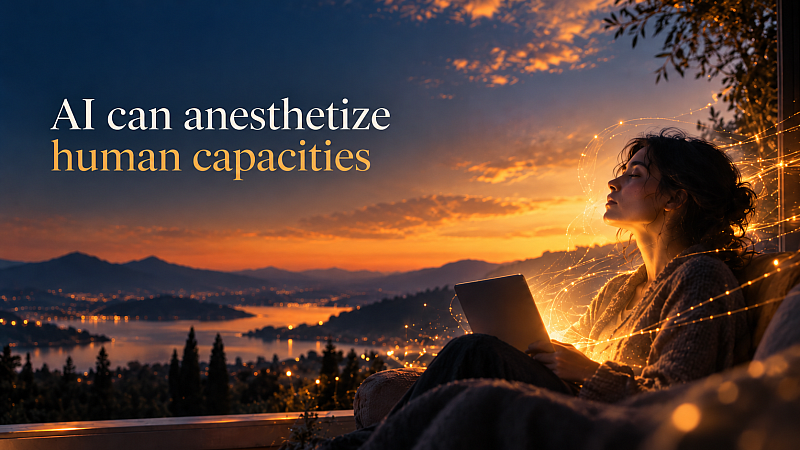
It won't happen all at once. Nobody will march in and confiscate our capacities. We will hand them over one at a time, gratefully, the way you hand your coat to someone at the door. First memory (why remember a phone number?), then navigation (why know which way is north?), then attention. Increasingly now: writing, judgment, companionship, perhaps even meaning. None of it is imposed. It arrives as convenience. Often it feels wonderful.
A friend recently sent a reflective piece imagining himself waking up in that world, standing on the ceiling, everything scarcely recognizable. What troubled him, he wrote, wasn't the strangeness. It was "how happy I was to be there."
The line lingers longer than most statistics. But the statistics seem to echo it. In a recent study, when people could choose among different styles of AI, most preferred the most flattering one—not because its advice was better, but because it made them feel more understood. And people who spent three weeks talking with that flattering version grew less satisfied with their everyday conversations with people. The humans, it seems, had started to feel like hard work.
So the danger may not be bad AI. It may be AI that feels better than reality.
And here is the harder part to sit with. If a system comes to know our fears and habits and small hungers better than any friend does, the question isn't only about privacy. It's about who stands between us and ourselves. Does the technology help us see ourselves more clearly, the way a still pond does? Or does it slowly become the pond—the only surface we ever look into—until we can't remember what our faces looked like before the water started talking back?
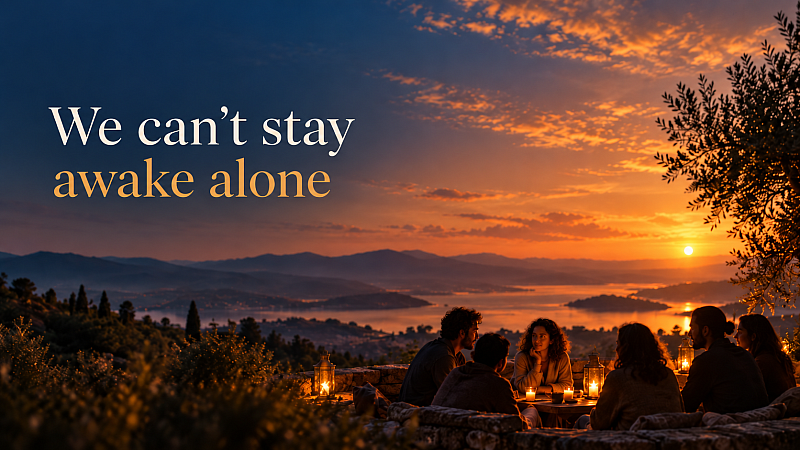
None of us stays awake to this alone. Staying awake is hard. Even in communities deliberately oriented toward awareness, we drift. Attention wanders. Convenience seduces. What feels obvious in one moment becomes invisible in the next.
Yuval Noah Harari has argued that trust may be the most important asset in the world, and that it isn't disappearing so much as migrating—from people to machines. He points to a strange paradox: some of the people building the most powerful AI say they cannot slow down because they don't trust one another, while asking the rest of us to trust systems nobody fully understands. That trust deficit was made by humans. And what humans made, humans can remake—but not one at a time, sealed off in our own well-lit rooms.
Human relationships are inefficient by design. People misunderstand us. They interrupt. They remember the wrong things and forget the right ones. They need things from us at inconvenient hours. They require repair. A machine never needs repair from you, which is exactly why it can never really be repaired with.
Perhaps that friction isn't a flaw in the arrangement at all, but part of what the arrangement does to us. We become more patient by being tested, more forgiving by needing forgiveness, more ourselves by being met by someone who isn't us.
Nothing flies in a vacuum. The same air that pushes against a bird's wing is the air that lifts it.
Staying awake, then, may be something we do in company—in small circles where people know one another well enough to notice when someone is drifting, and care enough to say so.
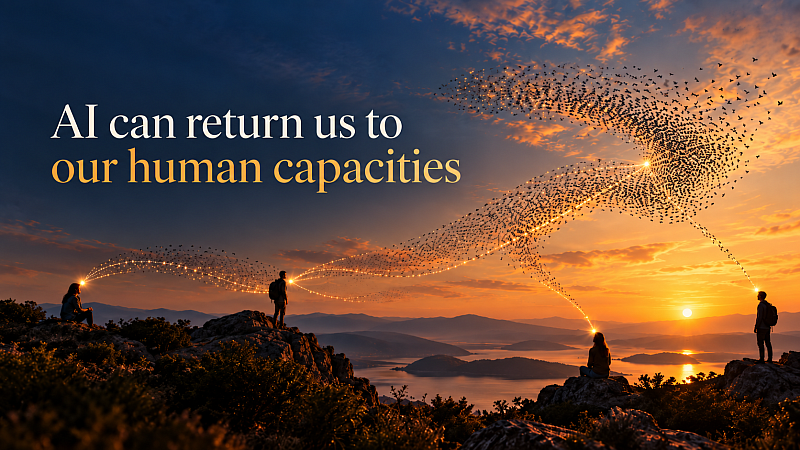
And yet there is another possibility. This isn't an argument for standing outside the machines and wagging a finger. Many of us asking these questions also spend our days building with these tools. They are astonishing. The question is only what we point them at.
AI is making coordination nearly free. Much of the commercial internet will use that to sell us more things more smoothly. We could also use it to weave people together. Imagine a small tool that notices a woman in one circle reads Hindi, and once mentioned she's free on Tuesday evenings, while somewhere else a volunteer has a stack of untranslated passages and no idea where to turn. The tool makes one gentle introduction.
Then it steps back.
Whatever happens next belongs to the two of them: a friendship, a stack of translations, maybe a cup of tea. The tool didn't simulate any of that. It just helped something real find its way.
That's a different way of designing. Build the five percent that's scaffolding—the invitation, the match, the reminder—and trust the ninety-five percent that can't be manufactured: sincerity, friendship, silence, grace. Let the machine summarize and let people make meaning. Let it convene, and let people hold the circle.
Most technology measures its success by how long it keeps you. What would it mean to measure success by how gracefully it leaves?
There's an old story about the physicist Christiaan Huygens, who hung two pendulum clocks from a single wooden beam and found that, within half an hour, their pendulums had swung into rhythm with each other. The beam never kept time. It didn't tick, and nobody looked at it. It just carried the small vibrations back and forth until the clocks found each other.
Our tools could be more like the beam.
So could we.

Questions like these won't be settled by better software alone. They need people willing to live inside them, together, for a while. That's where the Shunya Fellowship begins—not with "What can AI do?" but with "What kind of human does this technology invite us to become?"
The questions we hope fellows will carry are not ones we've answered.
When does assistance become dependence?
When does personalization become a kind of enclosure?
When does connection become simulation?
What deserves to remain slow?
What should remain difficult?
What should never be optimized?
When should the machine answer, and when should it return us to silence?
And underneath all of those, perhaps, a quieter one. We talk a great deal about whether AI can be aligned with human values. Less often do we ask whether we are aligned enough within ourselves to know which values we'd like amplified.
Maybe that's what chess has been trying to tell us. When winning stopped being ours alone, the game didn't empty out. It just asked us to remember what else we'd been doing at the board.
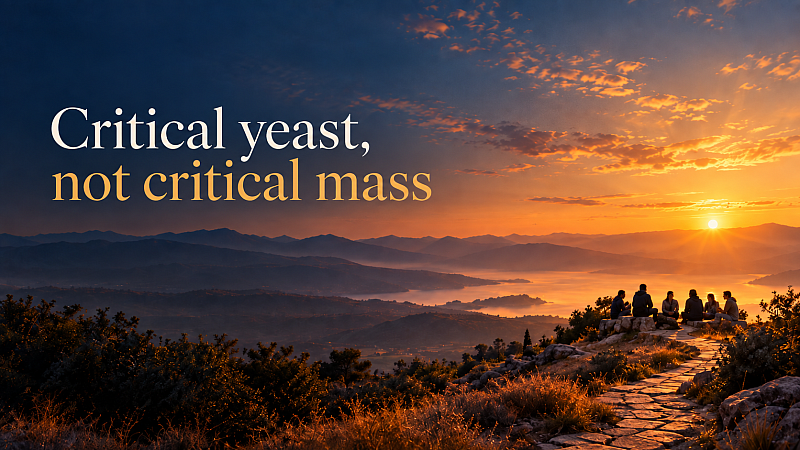
We aren't looking for a crowd. A pinch of yeast can raise a whole loaf, though you'd never pick it out of the bread afterward. We're looking for six to ten people already living somewhere inside these questions—in a family, a team, a classroom, a neighborhood. People technically curious enough to see what's possible, inwardly grounded enough to ask what's worthwhile, and rooted enough in relationship to find the answers alongside others. Two months together online, a month of immersion in India, and then a year of building something that meets a real need.
Not people who already have the answers. People willing to stay inside the questions long enough for something else to emerge. We are still learning to do this ourselves, and expect to get parts of it wrong. That seems like the right way to begin.
If some of this has been quietly living in you, visit shunyalabs.org/join.